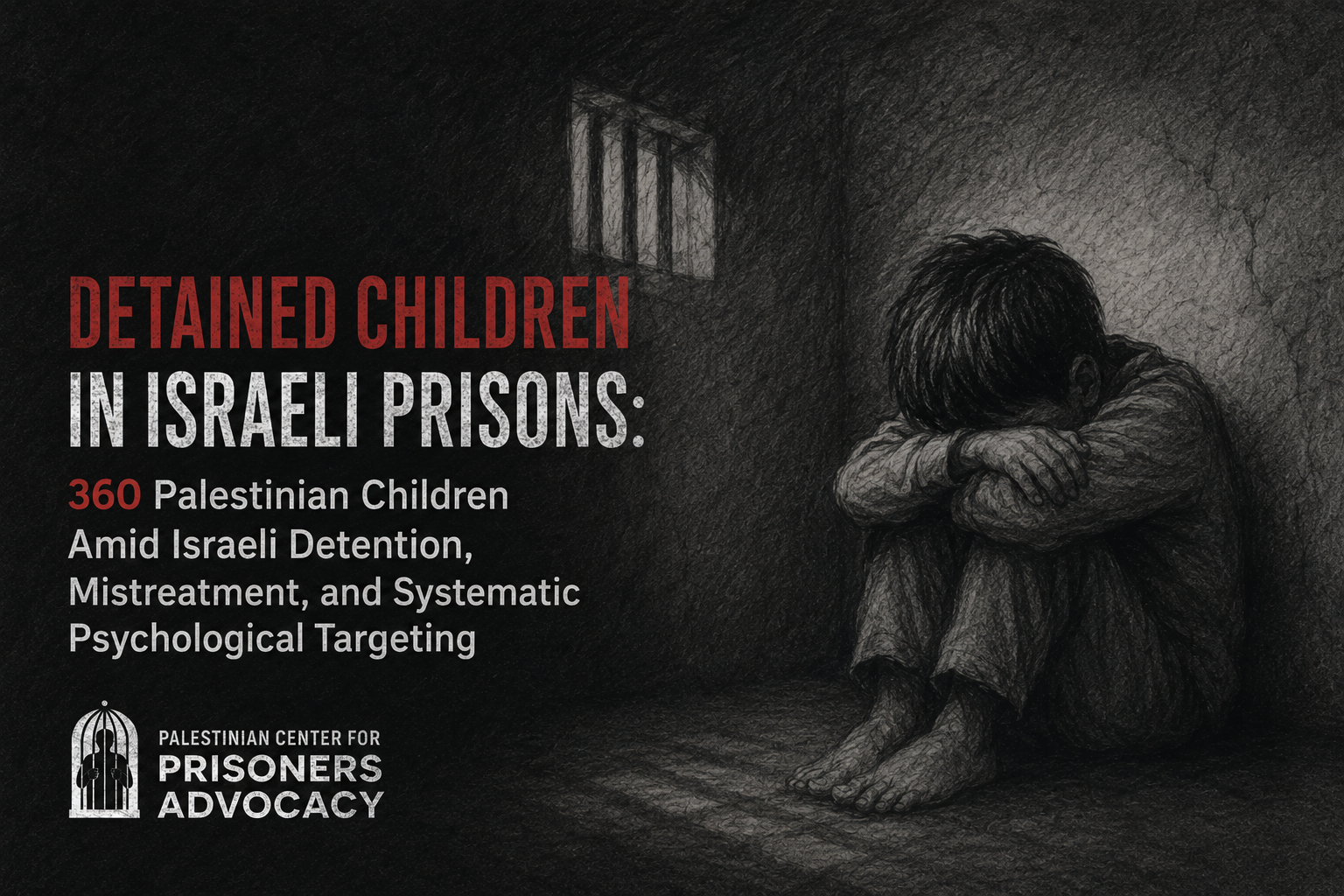
The issue of Palestinian minor prisoners in Israeli prisons remains one of the most sensitive files in the Palestinian human rights landscape, given that it concerns an age group that should be in classrooms and among their families, not behind bars, in interrogation rooms, or within the prison system. As arrests of Palestinian children continue, the health, psychological, and social consequences of imprisonment continue to accumulate, extending far beyond the period of detention and affecting these children’s lives for years afterward.
According to data available to The Palestinian Center for Prisoners Advocacy, approximately 360 Palestinian children are currently held in Israeli prisons. Among them, 160 children have received actual prison sentences, while 90 children are being held under administrative detention without charge or trial. The remaining children are awaiting the completion of legal proceedings before Israeli military courts. Most child prisoners are held in Megiddo and Ofer prisons, within sections designated for minors.
These figures form part of a broader context of targeting Palestinian children through arrest. Since 1967, more than 55,500 cases of child arrests have been recorded. In the past two years alone, more than 2,000 Palestinian children have been arrested. During the same period, cases were also documented involving the arrest of children under the age of ten. Meanwhile, uncertainty persists regarding the fate of several missing children from the Gaza Strip, amid human rights estimates suggesting that some may be held in detention or interrogation centers that have not been officially disclosed.
Arrest, Interrogation, and the Targeting of Childhood
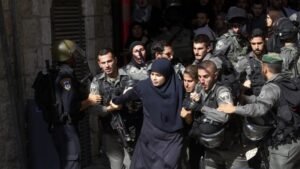
For Palestinian children, the experience of arrest often begins with night raids on family homes, accompanied by searches and intimidation of family members, before the children are transferred to detention and interrogation centers. This stage marks the first major turning point in the life of the detained child, who suddenly finds himself isolated from his family and natural environment in conditions that are incompatible with his age, needs, and psychological well-being.
During interrogation, children face varying levels of psychological pressure and prolonged questioning. Repeated human rights testimonies indicate that some children have been subjected to threats, humiliation, or psychological coercion aimed at extracting information or confessions. In recent years, complaints have also emerged regarding attempts to blackmail some children and exploit their psychological vulnerability or family circumstances in what are known as attempts at security and moral coercion.
The impact of this experience does not end with detention. It is often reflected in psychological disorders, behavioral challenges, and educational and social difficulties that may continue for varying periods after release. This is compounded by the deprivation of regular education, separation from school life, and exclusion from normal activities that are essential to a child’s development and growth.
Living Conditions Inside Prisons: Illness, Punitive Measures, and Restrictions on Religious Life
In recent months, reports have increased regarding the spread of infectious skin diseases inside prisons, most notably scabies, which has spread among detainees as a result of severe overcrowding, weak hygiene and sterilization measures, and shortages of basic health supplies.
Available data indicates that child prisoners have not been spared from these conditions. The overcrowded detention environment has accelerated the spread of infection, while complaints continue regarding delays in medical treatment and the limited healthcare available inside prisons. These conditions are particularly dangerous for children, as they belong to an age group that requires special healthcare and medical follow-up.
These difficult health conditions intersect with an even more complex daily reality, marked by overcrowded rooms, poor ventilation, shortages of clothing, blankets, and personal hygiene items, turning daily life inside prison into an environment of severe psychological and physical pressure.
These conditions are inseparable from a long series of punitive measures imposed on child prisoners. Prison sections are repeatedly raided by special repression units, often accompanied by violent searches, destruction of personal belongings, and collective punitive measures. Children also face various penalties, including solitary confinement for varying periods, heavy financial fines imposed on their families, deprivation of certain rights and basic needs, and repeated arbitrary transfers between prisons and sections. These measures impose additional psychological and humanitarian burdens on children and deepen the state of instability they experience within the detention system.
The restrictions imposed on child prisoners are not limited to living and health conditions; they also extend to religious and spiritual life. Child prisoners face increasing restrictions on collective religious practices, particularly during religious occasions and holidays. Cases have been documented in which gatherings related to prayer or the commemoration of religious occasions inside prison sections were prohibited or restricted. At times, punitive measures are imposed on prisoners who attempt to organize collective religious activities, as part of a policy aimed at limiting any collective practices that strengthen morale and bonds among detainees.
Collective Resilience and Efforts to Preserve Internal Cohesion
Despite the harshness of detention conditions, notable patterns of adaptation and internal solidarity emerge among child prisoners. Inside prison sections, relationships are formed based on mutual support, cooperation, and the sharing of daily needs, whether through emotional support or assistance in facing illness and the challenges of prison life.
Child prisoners continue to make efforts to preserve a collective spirit in the face of policies of isolation and individual targeting. Their daily experience reflects a strong commitment to protecting one another from various pressures, supporting newly detained children, and reducing the psychological impact of imprisonment. Forms of internal cooperation also emerge, helping to strengthen a sense of safety and belonging within an environment originally designed to dismantle and weaken human bonds.
Alongside the suffering of child prisoners, hundreds of Palestinian families live in a constant state of anxiety and anticipation regarding the fate of their detained children, particularly those arrested at a young age. The lack of sufficient information about their health and psychological conditions, the difficulty of communicating with them, and the repeated news of illnesses and punitive measures inside prisons all intensify families’ fears for their children. The experience of detention also leaves mutual social and psychological effects on both children and their families. Families face ongoing challenges in containing the consequences of detention, while children attempt to adapt to a harsh experience shaped by fear, deprivation, and longing for normal life.
These manifestations reflect a significant degree of psychological resilience among child prisoners, as well as their ability to resist the conditions imposed on them by building mutual support networks that preserve collective cohesion inside prison sections. At the same time, this reality exposes the scale of the challenges facing Palestinian childhood inside Israeli prisons, where arrests, interrogations, illness, and deprivation intersect with continuous efforts to preserve identity, dignity, and human bonds.
In light of the presence of 360 Palestinian children inside Israeli prisons, and the continued recording of hundreds of child arrest cases each year, the file of child prisoners remains one of the human rights issues most closely tied to the future of Palestinian society, due to the profound impact it leaves on an entire generation still in the earliest stages of life and development.
04 June 2026
International Day of Innocent Children Victims of Aggression
Palestinian Center for Prisoners Advocacy