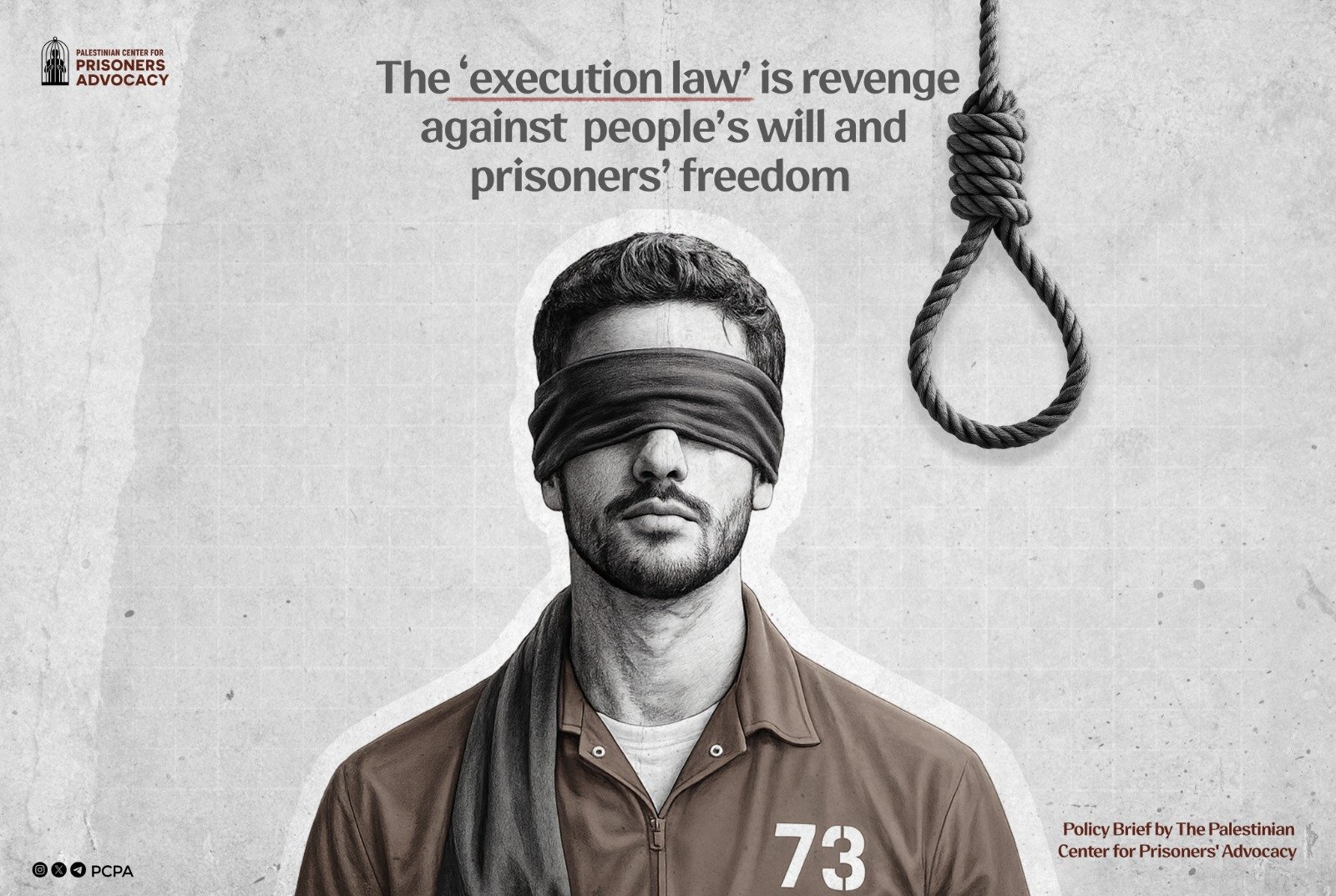
The Palestinian Center for Prisoners Advocacy affirms that the proposed law on the execution of prisoners currently being discussed in Israel represents the most serious legislative shift targeting the Palestinian prisoners’ movement since 1967. The bill carries significant legal, political, and humanitarian implications, directly affecting the right to life and the guarantees of a fair trial. It also seeks to redefine the relationship between the Israeli penal system and the prisoners’ file within the broader context of the ongoing conflict.
This proposal cannot be regarded as a limited technical amendment. Rather, it constitutes a strategic step aimed at transforming the death penalty from an exceptional and largely dormant provision into an enforceable deterrent tool within an official policy framework.
Legislative Developments
Since late September 2025, the bill has followed a practical legislative path within the Knesset. On 28 September 2025, it was announced that the bill had advanced in the National Security Committee in preparation for submission to the General Assembly. It subsequently passed its first reading on 11 November 2025 by a clear majority, thereby formally entering the detailed drafting stage for the second and third readings.
During December 2025 and January 2026, discussions continued within the relevant committees, accompanied by calls from right-wing leaders to expedite its approval and avoid leaving it within the scope of theoretical debate. Itamar Ben Gvir played a central role in advancing the bill, making it a key component of his political discourse. He publicly called for accelerating its enactment and implementation, describing it as a decisive deterrent tool and a political message intended to prevent future prisoner exchange deals. This was accompanied by media mobilization and direct incitement presenting execution as the ultimate solution in dealing with prisoners classified as security detainees
Main Provisions of the Proposed Law
The draft law stipulates the imposition of the death penalty on any person who intentionally, or as a result of what is defined as indifference, causes the death of an Israeli citizen if the act is linked to a racist motive, hatred, or the intent to harm the State of Israel.
The most serious concern lies not only in the expansion of offenses that may be punishable by death, but also in the proposed amendment of the procedural framework. The bill would allow death sentences to be issued by a majority of judges without requiring unanimity. It would also prohibit the mitigation or commutation of the sentence once a final judgment has been issued. This shift eliminates one of the most significant judicial safeguards associated with capital punishment and makes its implementation procedurally easier.
Human rights lawyer Abeer Baker described this direction as an unprecedented measure globally. Furthermore, the wording linking the offense to harm against the State of Israel as a state that unites the Jewish people and represents the revival of the Jewish people raises concerns regarding the discriminatory character of the legislation. There are fears that the law would, in practice, be applied almost exclusively to Palestinians, while it is not expected to extend under the same logic to crimes committed by settlers or Jews against Palestinians.
Broader Context and Human Rights Concerns
This legislative initiative comes within a long historical context of violations related to the prisoners’ file. Statistics from Palestinian human rights institutions indicate that hundreds of prisoners have died inside Israeli prisons since 1967 as a result of torture, medical negligence, or harsh detention conditions.
Introducing the death penalty in an environment where prisoners already report repeated violations deepens concerns regarding the absence of effective guarantees for fair trials. It increases the risk of irreversible injustice in the event that final death sentences are carried out.
Legal Implications
Legally, the bill includes amendments that would enable military courts in the West Bank to impose the death penalty on Palestinian civilians under the Anti-Terrorism Law. It also trends toward reducing the requirement of judicial unanimity and replacing it with a majority decision, in addition to limiting the possibility of pardon or sentence commutation after issuance.
These amendments constitute a fundamental infringement on the principle of individualized sentencing and on the procedural safeguards that must surround any death penalty ruling, given its irreversible nature. Expanding the jurisdiction of military courts to try civilians and impose death sentences raises serious concerns regarding judicial independence and impartiality.
International Reactions
International human rights bodies have expressed deep concern regarding the proposed bill, considering it contrary to the global trend toward restricting and abolishing the death penalty. Concerns have also been raised about the risk of discriminatory application.
Human rights institutions have warned that reducing fair trial guarantees in cases involving an irreversible punishment constitutes a direct violation of the right to life and relevant international standards.
Current Status and Call for Action
It is important to emphasize that the bill remains within the legislative process in the Knesset and has not yet completed the required second and third readings necessary for final adoption. Discussions are ongoing within the relevant committees, leaving a legal and political window for action before the proposed text is formally enacted.
In light of the grave risks posed by this bill to the right to life and fair trial guarantees, the Palestinian Center for Prisoners Advocacy believes that responsibility requires urgent action by international institutions and relevant United Nations human rights mechanisms to exert pressure to halt this legislative process before it becomes binding law and difficult to reverse.
The Palestinian Center for Prisoners Advocacy affirms that any legislation that opens the door to the execution of Palestinian prisoners constitutes a dangerous escalation and a serious violation of the principles of international humanitarian law and international human rights law. The Center calls upon the international community to take urgent action to protect the right to life, ensure fair trials that meet all legal guarantees, and address the root causes of ongoing violations against prisoners rather than advancing toward the imposition of the most extreme penalties.