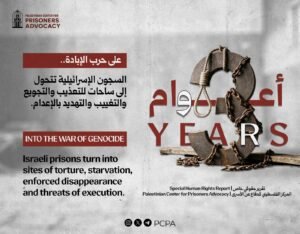
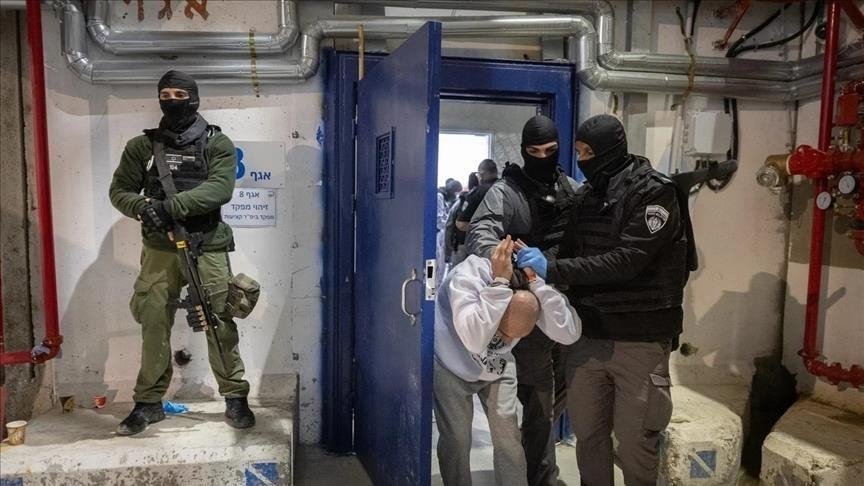
The Palestinian Center for Prisoners Advocacy has expressed profound concern and strong condemnation over the accelerated steps being taken by the Israeli occupation authorities to approve and implement legislation permitting the death penalty for Palestinian prisoners. Mounting indicators and concrete political moves suggest that this law is nearing activation. The Center views these developments as a dangerous escalation that directly threatens the lives of thousands of Palestinian prisoners and detainees held in Israeli prisons.
The approval and enforcement of such a law would constitute a stain on the conscience of the international community and humanity at large. It reflects an approach rooted in the language of killing and bloodshed in dealing with a people who have lived under occupation for decades. Continued international silence has emboldened the occupation to commit grave violations and serious crimes against the Palestinian people—foremost among them prisoners and detainees, who under international law are considered prisoners of freedom, and in many cases effectively hostages under coercive occupation authority, deprived of their fundamental rights.
The Center stresses that introducing the death penalty within the context of military occupation raises profound legal and moral concerns, particularly amid serious doubts regarding fair trial guarantees and the independence of the Israeli judiciary, which consistently operates in alignment with security and intelligence apparatuses. International humanitarian law and international human rights law impose strict limitations on the application of capital punishment and call for its progressive restriction leading to abolition.
The Center warns that this step would push the region into an even more dangerous cycle of conflict and instability, at a time when nearly 10,000 male and female prisoners remain in Israeli prisons, subjected to ongoing violations and systematic abuse. According to available data, more than 90 prisoners have died inside Israeli prisons over the past two years, while the bodies of several remain withheld—conduct that demonstrates alarming disregard for international law. In effect, the occupation is already implementing the logic of this law in practice.
Given the gravity of the current phase, the Center calls for the following:
First: The United Nations Security Council must adopt an urgent and decisive position, with permanent member states bearing responsibility to use their political leverage to halt this legislation.
Second: The League of Arab States and the Organization of Islamic Cooperation are urged to convene emergency meetings at the level of permanent representatives and foreign ministers to formulate a unified and forceful Arab and Islamic stance.
Third: International human rights organizations and the Arab Lawyers Union are called upon to undertake serious action commensurate with the unprecedented threat facing Palestinian prisoners.
Fourth: Palestinian official institutions, political factions, and grassroots movements are urged to build a unified national position leading to comprehensive action aimed at blocking and preventing the passage of this law.
In conclusion, the Palestinian Center for Prisoners Advocacy reiterates that the prisoners’ cause is fundamentally a humanitarian and human rights issue above all else. Any violation of prisoners’ right to life constitutes a grave breach of international legal and moral standards.