In a new sworn testimony obtained by the Palestinian Center for Prisoners Advocacy as part of its ongoing documentation of Israeli crimes against Palestinian prisoners and detainees, the Center presents one of the most significant and harrowing accounts to date, detailing an exceptionally violent period endured by thousands of detainees from the Gaza Strip.
The testimony is given by recently released prisoner Baha’ al-Din Hussein, a Palestinian content creator and social media influencer, who recounts his experience of arrest and detention.
Hussein states that on the evening of November 15, 2023, Israeli military forces intensified their assault on southern Gaza City, employing stun and smoke bombs, drone fire, artillery shelling, and live ammunition. His family home was struck by more than four shells fired from both the northern and southern directions.
The family had remained in Gaza until that point because Hussein’s father suffers from kidney failure. However, the destruction of Al-Shifa Hospital and the Indonesian Hospital left them with no option but to flee south, despite knowing that the entire southern Gaza Strip had only 20 dialysis machines, less than a third of those available in Al-Shifa Hospital alone.
As the bombardment escalated and military vehicles advanced, the family moved south along what was described as a “safe corridor.” Hussein recounts that while he was carrying his father in his arms, Israeli soldiers called him aside and ordered him to leave his father behind, despite his inability to walk. Behind a sand embankment, Hussein was forced to completely strip naked, then ordered to wear only his underwear. Two shots were fired near him before a heavily built soldier assaulted him and dragged him uphill.
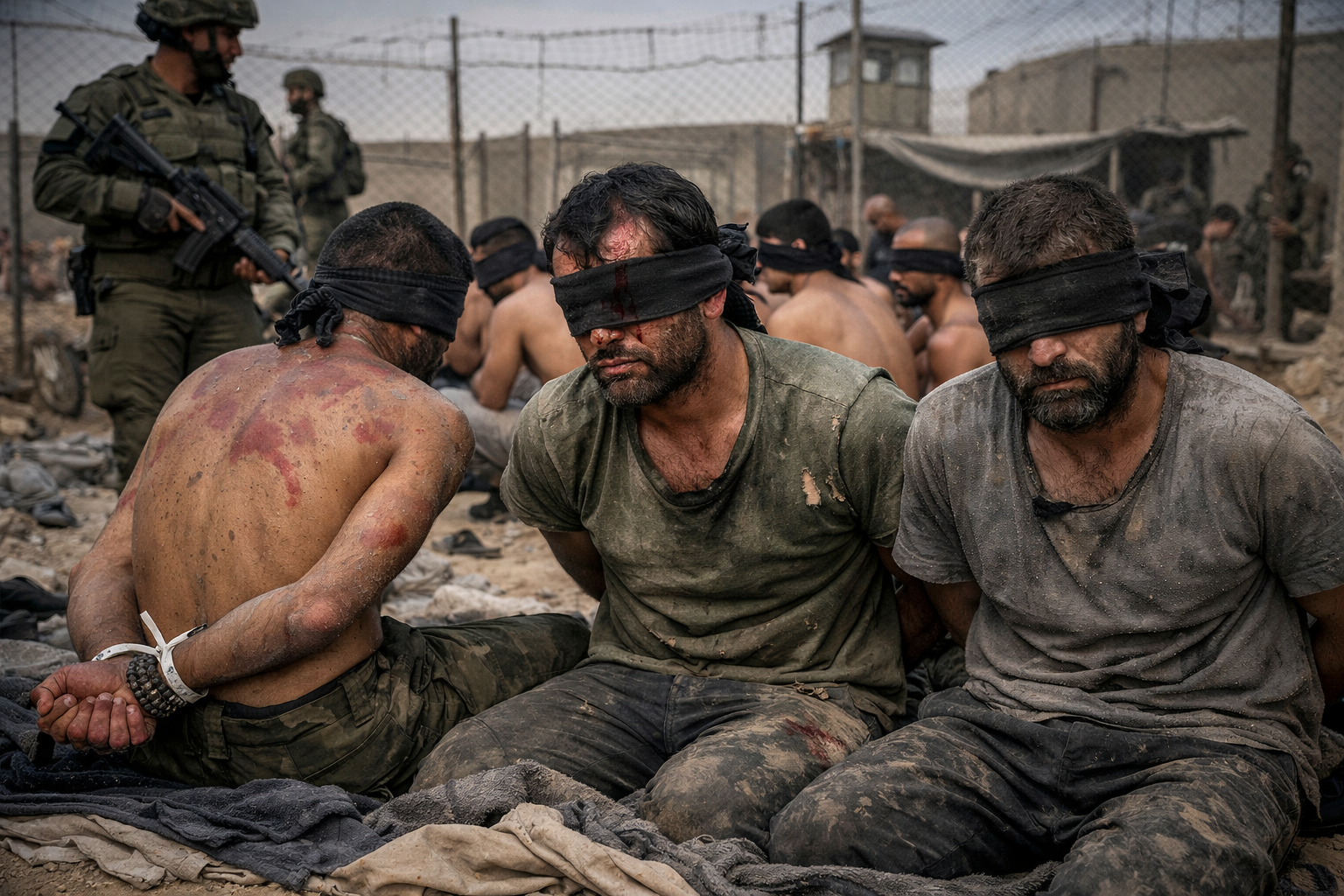
He was interrogated on the spot by an officer whom Hussein believes was Lebanese. The officer threatened to harm his family before Hussein was transferred to an area covered in gravel, where dozens of young men were already bound. After waiting for several hours, they were violently thrown onto trucks and transported to Sde Teiman military camp.
Hussein describes being handcuffed with plastic restraints and blindfolded at all times. Access to the bathroom was limited to one minute per visit, while detainees were forced to remain seated on their knees throughout the day on thin rubber mats no more than five millimeters thick.
He was later summoned by military intelligence for what was described as an interrogation. During this period, Hussein says he was subjected to severe beatings, resulting in a broken nose, prolonged stress positions, skin torn by restraints, death threats, insults, humiliation, and deprivation of food and water.
After four days of interrogation, he was returned to Sde Teiman under the same conditions: hands bound throughout the day, forced to kneel for up to 20 hours daily, and provided with three minimal meals consisting of two slices of toast per meal, a teaspoon of processed cheese, and half a tomato. He remained in Sde Teiman for seven days before being transferred with 35 other detainees to Negev Prison, where he would spend approximately 460 days.
Hussein describes being held in overcrowded rooms measuring roughly six meters by three meters, each containing a toilet and access to water for only one hour per day. The rooms had windows that could not be closed and housed up to 17 detainees with no consideration for age, health, or compatibility. Prisoners were denied personal hygiene items and cleaning supplies. Until May 2024, detainees were not provided with replacement clothing or underwear. Despite the harsh desert cold, prison authorities restricted the use of blankets from dawn until 6:00 p.m.
Each room contained only five beds, forcing 12 detainees to sleep on the cold floor, even during winter months. Among them were numerous prisoners over the age of 60.
Conditions did not improve after prisoners were transferred to tent sections, both old and newly installed. During the cold and rainy winter months, detainees were forbidden from closing the tents. Mattresses and blankets were confiscated at dawn and often not returned until late at night, sometimes after midnight. The tents regularly flooded with rainwater, with no intervention by prison authorities.
On May 5, 2024, the prison warden, accompanied by large security forces, violently suppressed one of the sections after prisoners demanded medical treatment. Hussein says many detainees’ bodies had deteriorated into skeletal forms, covered in continuously bleeding boils. In response, prison authorities assaulted the prisoners and confined them in a cage contaminated with bird droppings and rodents, accelerating the spread of disease.
Hussein further recounts frequent raids and punitive operations, including forced transfers, severe beatings, and the use of dogs, smoke bombs, and tear gas inside the tents. Prison authorities conducted invasive searches for pens, paper, small pieces of cardboard, and even empty bread bags, turning every object into a tool of collective punishment.
Until July 2024, prisoners were forced to access bathrooms one at a time, with only one detainee allowed to enter per 150 prisoners, despite the availability of six toilets. Food rations until July 7, 2024, averaged approximately 350 grams per person per day, consisting of six slices of toast, 50 grams of labneh, one small vegetable per day, a cup of rice (not exceeding 100 grams) or its equivalent in lentils or beans, with no salt or sugar, and limited quantities of eggs distributed inconsistently.
In December 2024, Hussein reports the first appearance of the Masada Unit at Negev Prison. Dawn raids involved the direct firing of rubber-coated bullets at detainees, causing injuries that were never treated. As collective punishments intensified, often justified by alleged “disorder”, prisoners were deprived of medical care, including treatment for chronic illnesses and access to basic medications such as painkillers and allergy tablets.
When detainees attempted to organize themselves to manage daily conditions and communicate with the administration, prison authorities responded by suppressing these efforts through solitary confinement, transfers, and food deprivation.
Hussein describes the most devastating phase of detention as the systematic denial of medical care. He states that at least four detainees died due to illness, including young men who succumbed after contracting scabies and suffering prolonged malnutrition. Prisoners frequently lost consciousness, particularly during daily counts, when they were forced to stand for over an hour under the scorching desert sun.
All of this, Hussein notes, occurred in the absence of any meaningful international humanitarian or human rights oversight. He concludes that detainees were effectively abandoned to face a deliberate system of lethal abuse, with prison guards employing multiple methods aimed at killing as many prisoners as possible.
According to the Center, as of December 2024, the number of Palestinian prisoners and detainees stands at approximately 9,300, including 1,300 sentenced prisoners, 51 women, 350 children, 3,200 administrative detainees, and 1,250 detainees held under the “Unlawful Combatant” law, all from the Gaza Strip and detained after October 7, 2023. The Center reports that all continue to face severe abuse and degrading treatment at the hands of Israeli prison authorities.