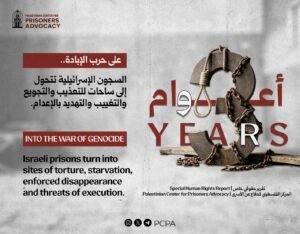
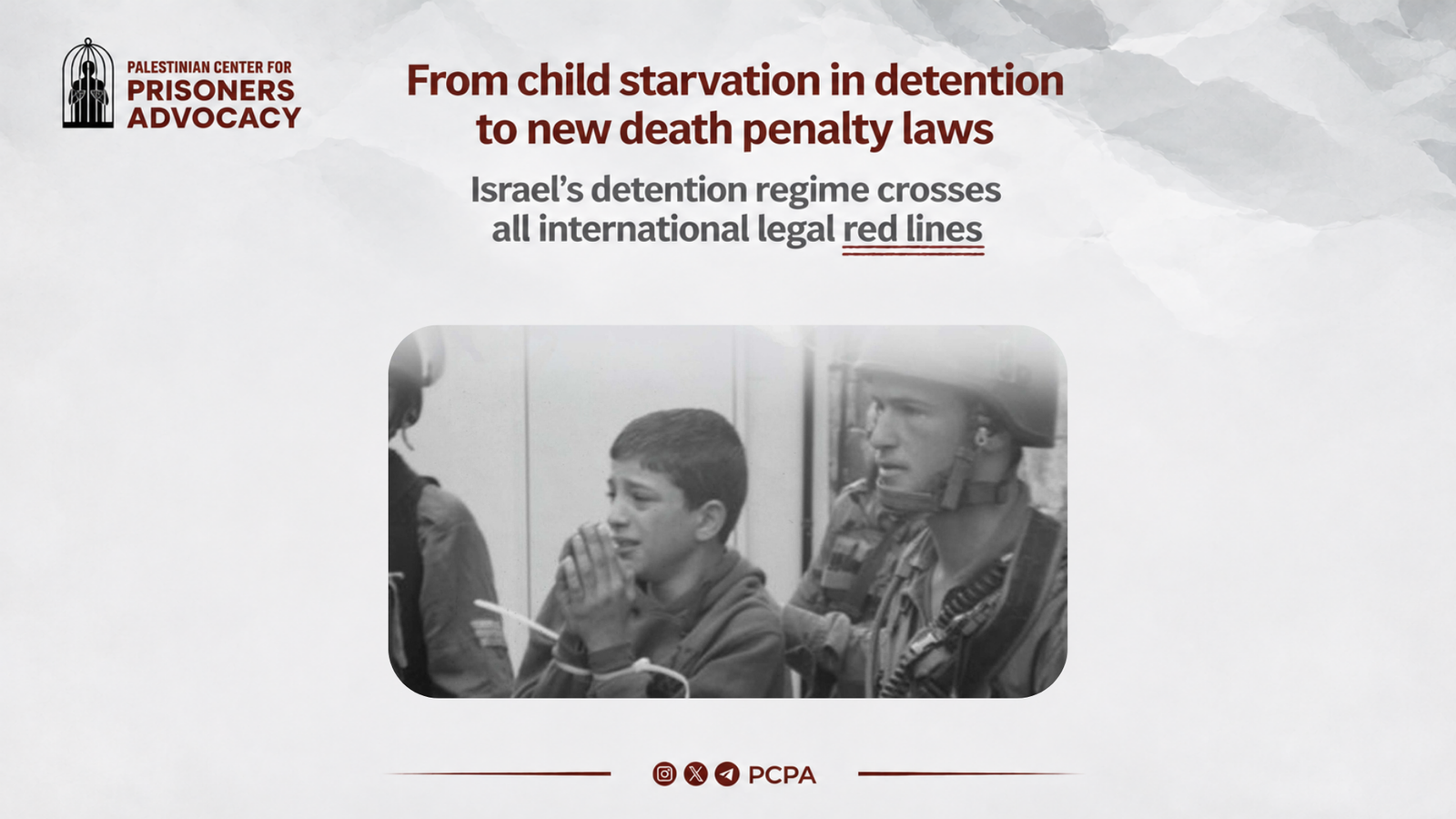
Since the beginning of 2026, Palestinian prisoners and detainees in Israeli custody have seen no improvement in their legal status or in their conditions of detention. They continue to face the harshest conditions since the start of the Israeli genocidal war on Gaza in 2023, including torture, threats, sexual violence, denial of basic health care, and a risk to their lives.
The Palestinian Center for Prisoners’ Advocacy considers that, throughout 2026, detainees’ fundamental rights and protections under international humanitarian law (IHL) have remained under growing threat, both from the laws enacted by the Israeli authorities and from the physical and psychological abuse committed by the Israel Prison Service (IPS). Current prison policies continue to endanger the lives of Palestinian prisoners.
-The Number of Palestinians in Israeli Custody and Their Legal Status
In June 2026, the IPS was holding around 9,200 Palestinians, including more than 1,500 from the Gaza Strip. Alongside the genocide in Gaza, occupation power continues to use its detention powers on a wide scale against the Palestinian population.
It is becoming harder to establish how many people are detained and under what legal status, because the occupation authorities have stopped or restricted the release of information that was previously available. The available data are therefore limited and subject to change.
Most Palestinians in custody are held as remand detainees or administrative detainees. The number of administrative detainees fluctuated between roughly 3,100 and 3,550 during the year. The number of people held as “unlawful combatants” rose to around 1,400 over 2026.
In the first half of 2026, the number of Palestinian women prisoners rose to around 100, including pregnant women.
Around 380 children were in Israeli custody in the first half of 2026. Some are held under the “unlawful combatant” designation, which leaves them with only minimal protection under IHL. According to the UN Secretary-General’s report on children and armed conflict (S/2026/357), which covers 2025, the UN verified the detention of 981 Palestinian children (973 boys and 8 girls). Of these, 978 were detained by Israeli armed and security forces for alleged security offences: 182 in East Jerusalem, 782 elsewhere in the West Bank and 14 in the Gaza Strip. 180 Palestinian children were held in administrative detention, without charge or trial, as of 31 December 2025, in addition to seven children transferred from Gaza and held under the “unlawful combatant” designation.
-Administrative detention
Administrative detention allows imprisonment without charge or trial and prevents detainees and their lawyers from seeing the evidence on which the detention is based. Orders are renewed repeatedly on the basis of a “secret file,” so detainees face indefinite detention without clear information about their legal situation, without trial, and without due process. The Center considers that Israel’s use of administrative detention against large numbers of Palestinians violates international humanitarian law.
Cases documented by the Center and others:
- Abdel-Salam Abu al-Haija was held in administrative detention from August 2022 and released in August 2026. His mother died during his detention, and after his release he visited her grave.
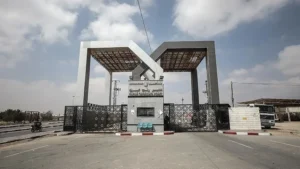
- Mohammed Jihad al-Shorbaji, 24, from Nuseirat refugee camp, was arrested while returning from Egypt through the Rafah crossing.
- Ahlam Ishtayeh was placed in administrative detention in May 2026 after soldiers stormed and ransacked her home. She was held for four months without a legal justification being provided
- Mutasim Tayseer Samara, from the village of Surra, Tulkarm, has been held in administrative detention since December 2022, with his order renewed for four months.
- Bushra al-Tawil, a journalist who continues to face ill-treatment, had her administrative detention order renewed for a further four months.
Recently, Israeli authorities issued new administrative detention orders or renewed existing ones for 15 Palestinian prisoners from across the West Bank for periods of three to six months.
– Detention Conditions, Deaths in Custody
In several prisons, including Damon and Negev, prisoners were denied basic health care, personal care items, and cleaning materials, and their religious practice was restricted. Prisoners were forced to sleep on the floor without proper bedding or blankets. Insufficient food has led to serious weight loss.
Prisoners with serious illnesses, including cancer, face denial of adequate treatment. For example, Shatila Abu Ayada, one of the longest-serving women prisoners, needs urgent medical attention because of rising liver enzymes.
Prisoners continue to be subjected to torture and other ill-treatment. According to victims’ testimonies, Israeli officials threatened women prisoners with rape in order to force them to withdraw complaints or provide information. The Center also received testimonies from women prisoners describing torture, sexual violence, lack of food, and lack of hygiene and personal care items.
The UN received testimonies from 66 children who reported physical violence and other ill-treatment in Israeli custody. One Palestinian boy died in detention, and autopsy findings raised concerns about extreme and probably prolonged malnutrition and inadequate medical care. [S/2026/357]
Role of the “unlawful combatant” designation
The Center assesses that the designation is used to justify torture and other violations, to weaken basic legal guarantees, and to impose prolonged detention without effective oversight.
Legal assessment
These conditions violate IHL and international human rights law. Article 86 of the Fourth Geneva Convention requires the detaining power to provide premises suitable for religious services. Article 93 guarantees internees complete latitude to practice their religion. Article 92 requires medical examinations at least once a month. Judging by prisoners’ accounts and their condition on release, Israel has failed to meet these obligations. The prohibition of torture and of cruel, inhuman, or degrading treatment is absolute under both IHL and international human rights law.
-Legal Changes and Court Rulings of Occupying Authority
Death penalty law (30 March 2026)
The Knesset passed a law, initiated by the party of National Security Minister Itamar Ben-Gvir, expanding the use of the death penalty in military and civilian courts. In the occupied West Bank, death is the default sentence for intentional killings classified as terrorism, and life imprisonment is permitted only in unspecified “special circumstances.”
Special military tribunal law (11 May 2026)
The Knesset passed, by 93 votes to 0, a law creating a special military tribunal with the power to impose the death penalty on Palestinians convicted of involvement in the 7 October 2023 operations.
Supreme Court ruling on ICRC visits (3 June 2026)
Since October 2023, Israel has barred the International Committee of the Red Cross (ICRC) from visiting Palestinian prisoners. On 3 June 2026, Israel’s Supreme Court unanimously rejected this policy. The ruling did not set a timeframe for resuming visits. It remains unclear to what extent Israel will comply, and there is no mechanism to impose consequences if it does not. The ban contravenes Articles 76 and 143 of the Fourth Geneva Convention, which entitle the ICRC to visit detainees and protected persons, inspect conditions in all places of detention, and communicate with detainees without witnesses.
Military court practice
On 18 August 2026, Israeli forces arrested Dr. Dima Amin after a night raid on her home, during which her hands were tied with plastic restraints and she was blindfolded. On 20 August 2026, the Ofer Military Court extended her detention by five days for interrogation on allegations of incitement on social media.
-International Mechanisms: Positions and Reactions
UN Special Rapporteur on Torture
The Special Rapporteur warned that the death penalty bill carries risks of serious violations of international law, including the absolute prohibition of torture.
UN Secretary-General
The Secretary-General’s April 2026 report on conflict-related sexual violence covers violence against Palestinians and recommends that all acts of sexual violence cease and that time-bound commitments be adopted to address and prevent them.
Humanitarian and rights organizations
A joint statement of 2 April 2026 said that the Knesset’s adoption of the death penalty law requires urgent EU measures.
The Center’s assessment
Despite these statements, there has been no visible change in Israel’s policy or in detainees’ conditions. Throughout more than three years of the war of genocide, which has included rising violence and ill-treatment inside prisons, international institutions and mechanisms, including the Security Council, have not taken effective action. Statements alone have not provided detainees with protection or access to independent monitoring.
-Conclusion and Recommendations
Three years after the start of the genocide, The Palestinian Center for Prisoners’ Advocacy considers that the reality of Israeli prisons has undergone an unprecedented transformation in both the scale and nature of violations. In 2026, this was compounded by new legislation, including the death penalty law of 30 March and the law establishing a special military tribunal on 11 May, as well as continued administrative detention on the basis of secret evidence and the continued holding of Gaza detainees under the “Unlawful Combatants Law.” Thousands of detainees now face conditions that go beyond imprisonment and pose a direct threat to their lives, health, and dignity.
The Center demands the immediate disclosure of the fate and whereabouts of all those who have been forcibly disappeared or gone missing; the opening of prisons and military camps to independent international monitoring, including Red Cross visits; effective legal representation for every detainee from the moment of arrest until release; the resumption of family visits; the provision of adequate food, medical treatment, clothing, and basic necessities; an end to solitary confinement and collective punishment; the repeal of the death penalty law and of the law establishing the special military tribunal; an end to administrative detention based on secret evidence; and the opening of independent investigations into cases of torture, death in custody, sexual assault, and medical neglect.
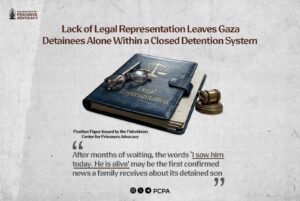
The Center stresses that, for a detainee from the Gaza Strip, the absence of legal representation means more than the absence of a lawyer. It removes one of the few independent witnesses to the detainee’s situation and severs a key channel between the detainee, his family, and the outside world. While the detainee appears only every few months on a screen for a review of his detention, his family may not know where he is held or be able to reach him. Ensuring an effective lawyer for every detainee from the Gaza Strip, from the moment of arrest until release, should therefore be a priority for any human rights and legal action in the coming period.
The Center calls on the International Committee of the Red Cross to resume visits to all detainees and places of detention, including Gaza detainees held in military facilities, with confidential individual meetings, and to help establish the fate of missing and forcibly disappeared detainees.
The Center also calls on the United Nations and on international human rights and humanitarian organizations to assume their responsibilities and to move from statements and declarations to concrete measures that ensure the protection of detainees and hold those responsible for violations accountable.
The most serious reality that these years have revealed is that prisons have become another arena of Palestinian suffering. Leaving detainees outside oversight and accountability threatens to produce more victims. Protecting their lives, establishing the fate of the disappeared, and stopping the violations against them are no longer demands that can be postponed. They are an urgent humanitarian and legal responsibility of the international community and its institutions.
November, 2026
Palestinian Center for Prisoners Advocacy
Erva Kardelen Akyüz