September 2026
The Palestinian Center for Prisoners Advocacy believes that the lack of effective and regular legal representation for detainees from the Gaza Strip is one of the most serious aspects of the detention situation since Oct. 7, 2023. Denying a detainee access to a lawyer not only undermines the right to defend oneself but also cuts off one of the most important means of protection through which a detainee’s whereabouts, health condition and treatment inside prison can be determined.
For nearly three years, large numbers of Gaza detainees have spent prolonged periods isolated from their families, lawyers and international organizations. Families have continued searching for their relatives without clear information. In documented cases, families learned where their relatives were being held only after legal intervention and formal requests were submitted to determine their whereabouts. HaMoked has documented the detention of hundreds of Gaza residents incommunicado and at unknown locations during different stages of the war.
The absence of a lawyer cannot be viewed as a separate legal issue. It is directly linked to the lack of information, the detainee’s isolation from family, difficulties documenting violations, delays in discovering illness or injury, and the detainee’s limited ability to challenge continued detention or understand the legal basis invoked by Israel for keeping them behind bars.
The “Unlawful Combatant” Framework Keeps Detainees Away From Criminal Trial
Israel handles large numbers of Gaza detainees under what it calls the “Unlawful Combatants Law,” an Israeli legal classification that has drawn serious objections from rights organizations. HaMoked argues that the law creates a category that does not exist in this form under international law and deprives detainees of fundamental safeguards to which people deprived of their liberty should be entitled.
The latest published figures for September 2026 show that Israel classifies 1,393 detainees as “unlawful combatants,” out of 9,329 Palestinian prisoners and detainees listed in Israeli prison authorities’ data.
The Center believes that applying this designation to Gaza detainees cannot justify stripping them of fundamental safeguards or holding them for prolonged periods without criminal trial, particularly because this framework allows detention to continue on the basis of material that may remain secret, making it extremely difficult for detainees to know the evidence being used against them and respond to it.
The problem is therefore not limited to terminology, but to its practical consequences. A detainee may remain imprisoned for many months or longer without a criminal indictment, while their ability to access a lawyer and examine the material used to justify their continued detention remains limited.
A Lawyer Is More Than a Representative Before the Court
For a prisoner from the Gaza Strip, a lawyer is not merely someone who follows their case before a court. The lawyer may be the first person from outside the prison system whom the detainee has seen in weeks or months.
Through a visit, a lawyer can determine whether the detainee is ill or injured, hear complaints of beatings, torture, starvation or detention conditions, relay information to the family, seek medical treatment, document what the detainee has experienced, determine their legal status and challenge continued detention.
Preventing or delaying access to a lawyer therefore does not merely deny prisoners legal defense; it deprives them of one of the few remaining means of communicating with the outside world.
This becomes even more serious for Gaza detainees in light of the suspension of family visits and the absence of direct communication with relatives. In many cases, the lawyer becomes the only person able to tell a family that their relative is being held at a particular location, that they have personally seen and spoken to them, and that they can provide information about their condition.
A Family May Appoint a Lawyer — But Can the Lawyer Reach the Detainee?
Families of Gaza detainees have faced severe restrictions on their ability to secure meaningful legal access to their relatives. Even when a family manages to contact and privately retain a lawyer, this does not automatically mean that the lawyer can determine the detainee’s whereabouts or visit them.
Months after the war began, in May 2024, Israel for the first time provided an email address for submitting requests to coordinate meetings between lawyers and Gaza detainees. This followed legal action and petitions filed by HaMoked. Before that, Israel had refrained from providing families with direct information about detainees’ whereabouts, while emergency amendments during parts of the war also allowed detainees to be prevented from meeting lawyers for prolonged periods.
The problem therefore does not concern only a family’s financial ability to hire a lawyer, but also whether that lawyer can actually reach the client. The right to appoint a lawyer has limited value if the detainee’s location remains unknown, a visit request is rejected or delayed, or the detainee is subject to an order preventing contact with a lawyer.
The Center therefore stresses the need to distinguish between having a lawyer formally appointed in a prisoner’s name and having genuine, regular legal representation through which the lawyer can meet the client confidentially, assess their condition, follow their case and challenge continued detention.
Families Searching for Their Relatives for Years
One of the harshest aspects of this issue is that large numbers of families of Gaza detainees have spent prolonged periods over the past three years without direct and reliable knowledge of their relatives’ whereabouts. Families have been forced to search through organizations, lawyers and rights groups simply to obtain information about where their relatives are being held.
HaMoked says it has effectively become one of the main channels Palestinians in Gaza turn to in order to locate detained relatives because information is not provided directly to families. It has also documented cases involving people last seen near Israeli forces or in Israeli custody whose whereabouts Israeli authorities later said they could not determine.
For families, not knowing where a detained relative is being held is not an administrative issue. A mother wants to know whether her son is alive. A father wants to know whether he is sick or injured. A wife and children wait for any call or information. Months may pass without a visit, phone call or direct update.
The absence of a lawyer intensifies this anxiety because one of the most important channels capable of answering these questions is itself closed or severely restricted.
A Hearing Through a Screen Every Six Months Is Not Enough
Under the “Unlawful Combatants Law,” permanent detention orders are subject to judicial review by an Israeli district court judge, followed by periodic reviews every six months for as long as detention continues, according to Israeli authorities’ own description of the procedures under the law.
During 2026, Israel also extended emergency arrangements allowing hearings and legal proceedings concerning these detainees to be conducted by video link. Rights organizations have criticized this arrangement, arguing that a detainee’s appearance through a screen limits a judge’s ability to directly assess the detainee’s physical and psychological condition.
Rights organizations have received testimonies indicating that some detainees have only limited participation in these hearings. The Center therefore believes that simply appearing on a screen once every several months does not in itself provide an adequate safeguard if the prisoner cannot speak freely about detention conditions, understand the grounds being used against them, and obtain meaningful legal assistance enabling them to challenge continued detention.
Genuine judicial review cannot be measured merely by whether a hearing takes place. It must be measured by the detainee’s ability to defend themselves, understand the allegations or grounds against them, communicate with their lawyer, raise objections without fear, and ensure the judge receives a full picture of their detention conditions and health.
From the Absence of a Lawyer to the Absence of Information
There is a direct relationship between legal representation and the ability to determine a detainee’s whereabouts. A family needs a lawyer to reach its detained relative, while the lawyer needs to know where the detainee is being held in order to visit them. When the place of detention is unknown or a detainee is barred from meeting a lawyer, a closed circle develops that is extremely difficult to break.
The mechanism announced by Israel to coordinate some lawyer visits linked obtaining information about a detainee’s location to the procedures for arranging the visit, effectively making legal coordination itself one of the ways of determining where a detainee is being held.
This illustrates the scale of the problem. The whereabouts of a person deprived of liberty should not primarily depend on whether a lawyer or rights organization succeeds in pursuing information from various authorities. Every detainee should be registered from the moment of arrest, their place of detention identified, and their family and lawyer immediately informed of any transfer between detention facilities.
Lack of Oversight Increases Risks to Prisoners’ Lives
The longer a detainee remains without access to a lawyer, the longer injuries, illness or mistreatment may go undetected, and the longer it takes to file a complaint or request a medical examination. Documenting what a detainee experienced also becomes more difficult after weeks or months have passed.
This is particularly serious in light of repeated testimonies emerging from prisons and detention camps in recent years concerning beatings, starvation, restraints, medical neglect, deprivation of hygiene and isolation. A detainee who is seen by no lawyer, family member or international body becomes increasingly isolated and less able to seek protection.
A lawyer’s visit should therefore not occur only after reports emerge that a prisoner’s health has deteriorated or that they have been assaulted. Regular legal access should be guaranteed from the beginning of detention because a lawyer’s role is not simply to document violations after they occur, but also to help prevent detainees from remaining beyond any form of independent oversight.
The Human Dimension: “I Saw Him Alive”
On paper, a lawyer’s visit may appear to be an ordinary legal procedure. For a family in the Gaza Strip, however, it can carry an entirely different meaning.
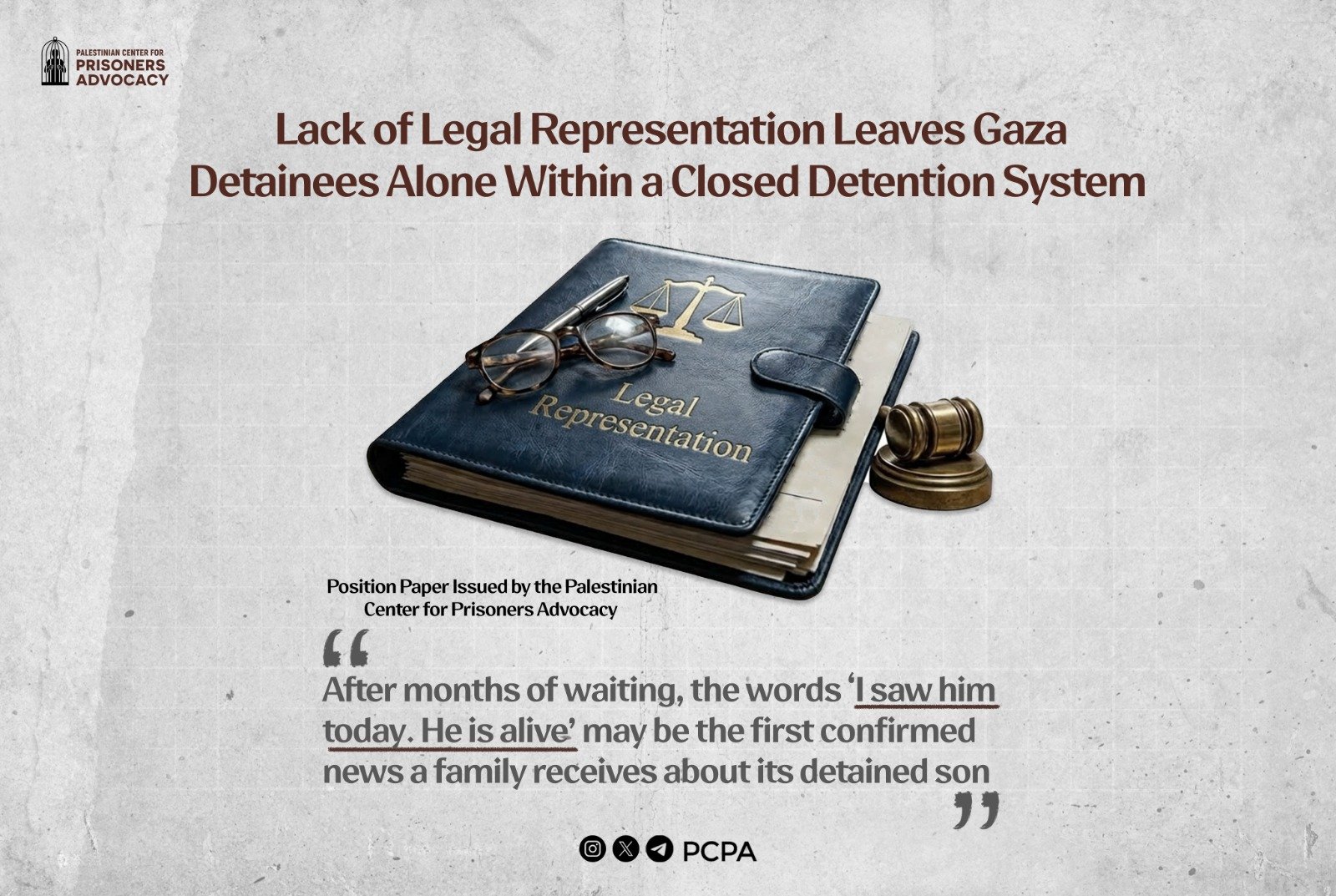
After months of waiting, a simple statement from a lawyer such as, “I saw him today. He is alive,” may be the first confirmed information the family has received about their detained relative.
At the same time, the prisoner may not know what has happened to their own family during the war — whether their home still stands or whether their parents, spouse and children are still alive. In some cases, the lawyer becomes the first person able to bring the detainee news about their family.
Separating a prisoner from both lawyer and family therefore creates suffering that extends far beyond the legal case. Both sides remain trapped in uncertainty: the family does not know what happened to its relative, and the prisoner does not know what happened to their family.
Assessment of the Coming Period
The Palestinian Center for Prisoners Advocacy assesses that continued lack of regular legal representation will leave Gaza detainees among those most vulnerable to isolation and violations, even if there is some limited improvement in visits or procedures.
Any discussion of restoring humanitarian oversight inside prisons will remain insufficient unless it is accompanied by guarantees that lawyers can regularly access all Gaza detainees, determine their whereabouts, and meet them confidentially without monitoring by prison authorities and without detainees facing threats or retaliation after visits.
Any resumption of visits by the International Committee of the Red Cross should complement, rather than replace, the role of lawyers. ICRC visits serve a humanitarian and monitoring function, while lawyers safeguard detainees’ rights to legal defense and follow-up. Prisoners need both.
The Center believes that continued application of the “Unlawful Combatants Law” in its current form to Gaza detainees will leave the door open to prolonged detention without trial and make independent legal representation capable of following each individual case even more essential.
What Is Required
The Center believes that addressing this issue should begin with establishing a complete and continuously updated registry of all Gaza detainees. It should include the location and date of each person’s arrest, the authority holding them, their current place of detention, and their legal and health status. Families and lawyers should be immediately notified of any transfer between prisons or detention camps.
Every detainee should also be guaranteed access to a lawyer from the beginning of detention. Restrictions that obstruct this right should be lifted, families should be allowed to select and appoint lawyers, and such appointments must have practical effect by allowing lawyers to locate their clients, visit them regularly and confidentially, and follow their health and legal conditions.
The Center also calls for judicial reviews of Gaza detainees’ detention to be genuine rather than merely formal proceedings conducted through a screen. Detainees must be able to speak freely before judges, consult their lawyers, understand the grounds for their continued detention and effectively challenge those grounds.
The Center further calls on Palestinian legal institutions to establish a unified mechanism for following Gaza detainees so that every detainee has an individual legal file and a lawyer responsible for their case, along with a database documenting their place of detention, lawyer visits, health condition and related judicial proceedings. Follow-up should not remain dependent on each family’s individual ability to search for information.
The United Nations, the International Committee of the Red Cross and international human rights organizations have a responsibility to press for full legal access to Gaza detainees, follow cases in which lawyers are prevented from visiting, and determine the fate of detainees whose families do not know their whereabouts.
The Center’s assessment is that the absence of legal representation for a Gaza detainee means more than the absence of a lawyer. It means the absence of one of the most important independent witnesses to the detainee’s condition, the loss of a key channel through which their voice can reach their family and the outside world, and the weakening of their ability to challenge detention, seek medical treatment or document what they endure.
While a detainee may appear every several months on a screen for a review of continued detention, their family may remain only a few dozen kilometers away without knowing where they are or being able to reach them.
Guaranteeing effective legal representation for every detainee from the Gaza Strip, from the moment of arrest until release, should therefore be among the priorities of any human rights and legal action in the coming period.
Palestinian Center for Prisoners Advocacy
September 2026