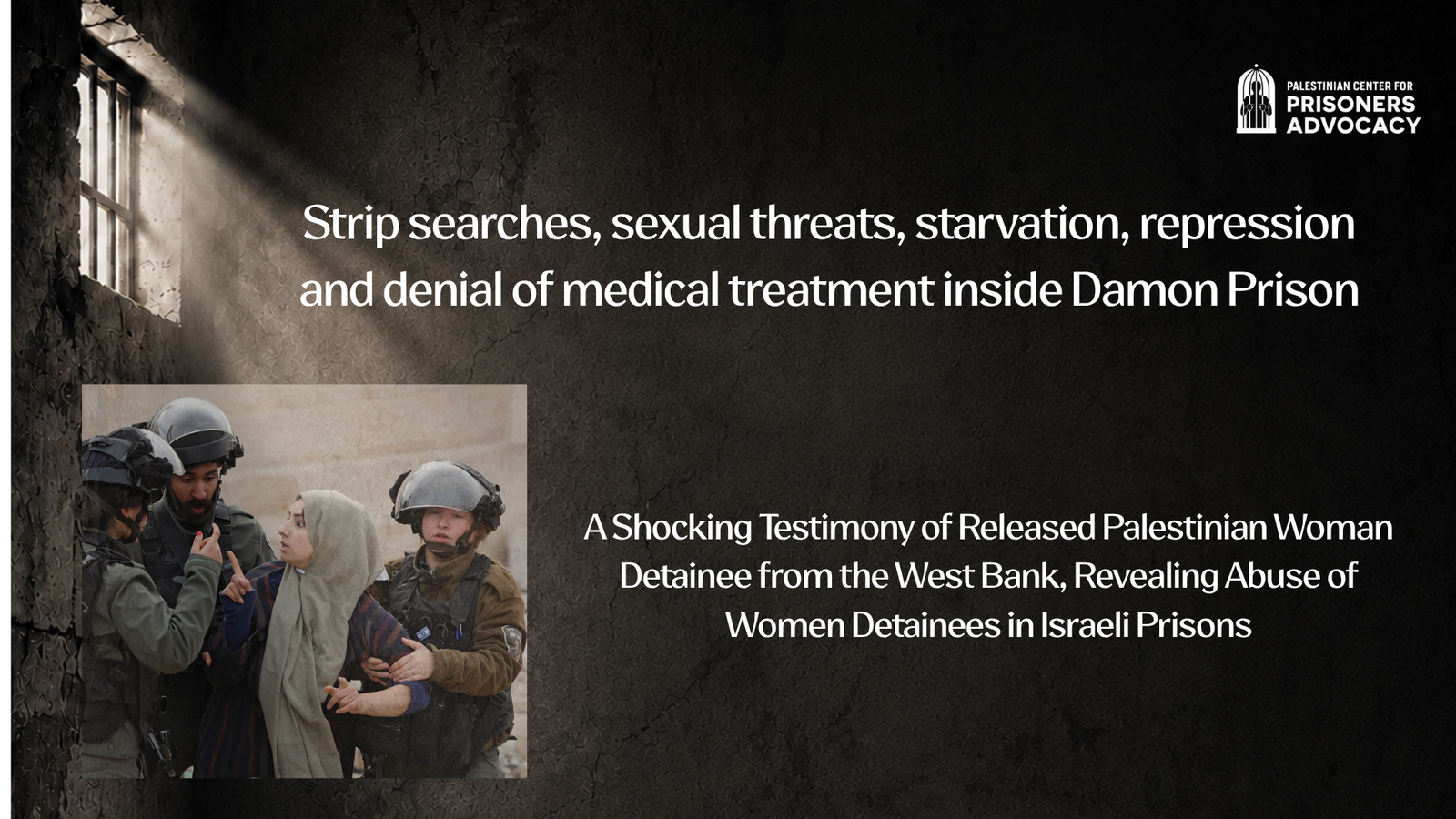
Strip searches, sexual threats, starvation, repression and denial of medical treatment inside Damon Prison
The Palestinian Center for Prisoners Advocacy documented an exclusive testimony from a released Palestinian woman detainee from the occupied West Bank, in which she described the details of her arrest and the abuse she endured, from the moment Israeli forces stormed her home until she was transferred to Damon Prison.
Her testimony includes accounts of beatings, humiliation, sexual threats, strip searches, solitary confinement, starvation, and denial of medical care and hygiene.
The Center is publishing the testimony anonymously and has removed any information that could reveal the identity of the woman or other detainees, out of concern that they could face rearrest or persecution.
The released detainee said Israeli forces stormed her home after midnight and surrounded the area with large numbers of soldiers. They then blew open the front door, separated members of her family, searched and damaged the contents of the house, and confiscated mobile phones, computers and electronic equipment.
She said an officer told her she had only one minute to get dressed before being arrested, while female soldiers refused to grant her any privacy as she changed her clothes.
“From the first moment, they did not only take away my freedom. They began humiliating me in front of my family and inside my own home,” she said.
During her transfer in a military vehicle, she was thrown onto the floor while handcuffed and blindfolded. She was kicked, stepped on, insulted and subjected to sexual threats.
“I remained on the floor throughout the journey, beneath the soldiers’ feet and rifles. They threatened to rape me and laughed, and I could do nothing,” she said.
Upon arriving at a military camp, she was forced to kneel for more than 15 hours while shackled and blindfolded. Throughout that period, she was denied food, water and access to a toilet.
At the detention center, she was taken to a strip-search room, where two female soldiers forced her to remove all her clothes. She was then subjected to physical touching that she described as sexual assault unrelated to any legitimate search procedure.
“What happened was not a search. It was a sexual assault while I was unable to protect myself,” she said.
She was also forced to kiss the Israeli flag and was photographed before a black bag was placed over her head and she was transferred to a solitary confinement cell.
She described the isolation cell as extremely small, with no fresh air or natural light. It contained an exposed toilet and a thin mattress placed beside it, while a bright light remained switched on continuously and the cell was extremely cold.
She said she lost all sense of time and could no longer distinguish between day and night.
During one stage of the interrogation, her hands and feet were tied to an iron bed inside an underground cell. She remained unable to move for more than 10 hours while insects and cockroaches crawled around her.
She said guards forcibly removed her hijab, threw it onto the floor and stepped on it. They refused to return it despite her repeated requests.
“I was tied to the bed, watching them step on my hijab, and I could not even stretch out my hand to lift it from the floor,” she said.
After several days of solitary confinement and interrogation, she was transferred to Damon Prison while suffering severe physical and psychological effects. However, she said the repression did not stop.
She explained that prison repression units repeatedly raided the sections, using stun grenades, smoke grenades, dogs and cameras. They then forced the women detainees to lie face down and tied their hands behind their backs.
She said soldiers dragged the detainees toward the prison yard while they were blindfolded and restrained. Their arms were forced upward behind their backs in a way that caused shoulder and back injuries, as well as bruising across their bodies.
“The detainees’ faces struck the ground, and some soldiers placed their feet or knees on their backs with full force,” she said.
According to the testimony, any word or scream from one detainee could result in collective punishment for the entire section through beatings, isolation and sexual threats.
Prison forces also confiscated plastic spoons and forced the women to eat with their hands.
The released detainee described the food as extremely limited and insufficient to ease their hunger. Meals consisted of small amounts of yogurt or jam, a few chickpeas or beans, and two spoonfuls of rice or bulgur, without salt or sugar.
“We went to sleep hungry, and we could hear each other’s stomachs because of the severity of the hunger,” she said.
She explained that the same food was given to pregnant women, sick detainees and elderly women, without any consideration for their medical conditions. As a result, some detainees lost a significant amount of weight.
Many women also suffered from menstrual irregularities and severe constipation due to malnutrition, psychological pressure and harsh health conditions.
The released detainee spoke of water that was unfit for drinking, coming from deteriorated taps filled with rust and chlorine. The detainees were also deprived of hygiene products and personal-care items.
She said women used toothbrushes to comb their hair and cleaned utensils with small pieces cut from their sleeping mattresses.
The bathrooms provided no privacy. In some rooms, they had no doors, while surveillance cameras were positioned above the areas where the women slept.
Each detainee received only a very limited number of clothing items and was forced to wash them, wait for them to dry and wear them again on the same day.
She added that fear of raids forced detainees to sleep fully dressed because the doors could be opened at any moment or bright lights could be shone into their faces during the night.
According to the testimony, the cells were severely overcrowded and held more detainees than they could accommodate. This forced some women to sleep on the concrete floor amid dampness and insects.
These conditions caused the spread of skin diseases and sores, without meaningful medical treatment or follow-up.
The released detainee said one pregnant prisoner lost consciousness because of a medical emergency. Other detainees attempted to save her for more than 15 minutes before prison staff arrived and merely instructed them to give her water and raise her legs.
She also spoke about a detainee who was severely beaten in the lower abdomen and between the legs, causing bleeding and serious health complications, without receiving the necessary medical treatment.
She said pregnant detainees endured harsh conditions, with some forced to sleep on the floor because there were not enough beds, despite suffering from fainting spells and other health problems.
She added that copies of the Quran were confiscated and no designated places for prayer were provided. The women were also deprived of knowing the time and had to estimate prayer times by observing the shadow of the sun during their limited time in the prison yard.
“We lived without a clock, without sunlight and without life,” she said.
On one night during Eid al-Adha, repression units stormed the section before dawn using grenades, dogs and weapons. They beat the detainees and threw them onto the ground.
“We spent the first hours of Eid treating one another’s wounds instead of celebrating and reciting the takbeer,” she said.
The released detainee revealed that prison authorities displayed photographs of the destruction in the Gaza Strip opposite the cells, with the words “The New Gaza” written on them, as a means of psychologically torturing the women and increasing their fear for their families.
Many women also remained in administrative detention without charge, with their detention orders repeatedly renewed whenever their expected release dates approached.
She said the detainees included mothers, grandmothers, young women, minors and women suffering from chronic illnesses. Some lost family members while in detention and were denied the opportunity to say goodbye.
She explained that court sessions held by video link became another occasion for humiliation, as detainees were violently dragged and pushed while being taken to the video-conference room.
The released detainee said the most painful part of her release was the feeling that she had left the other women behind in those conditions.
“I left the girls suffering from hunger, illness, sores and fear. Sometimes I feel that I have failed them because they are still there,” she said.
She concluded her testimony by saying: “There are no words that can describe the reality inside Damon Prison. I am still afraid to reveal everything that happened, but I do not want the suffering of the women detainees to remain hidden.”
The Palestinian Center for Prisoners Advocacy stressed that this testimony reflects a grave aspect of the violations committed against Palestinian women detainees and requires urgent international action to end strip searches, sexual assaults, starvation, medical neglect and ongoing repression.
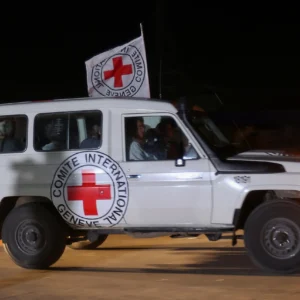
The Center called on the United Nations, the International Committee of the Red Cross and organizations concerned with women’s rights to send independent committees to Damon Prison, meet directly and confidentially with the women detainees, provide them with protection and medical care, and hold accountable those involved in the crimes and violations committed against them.