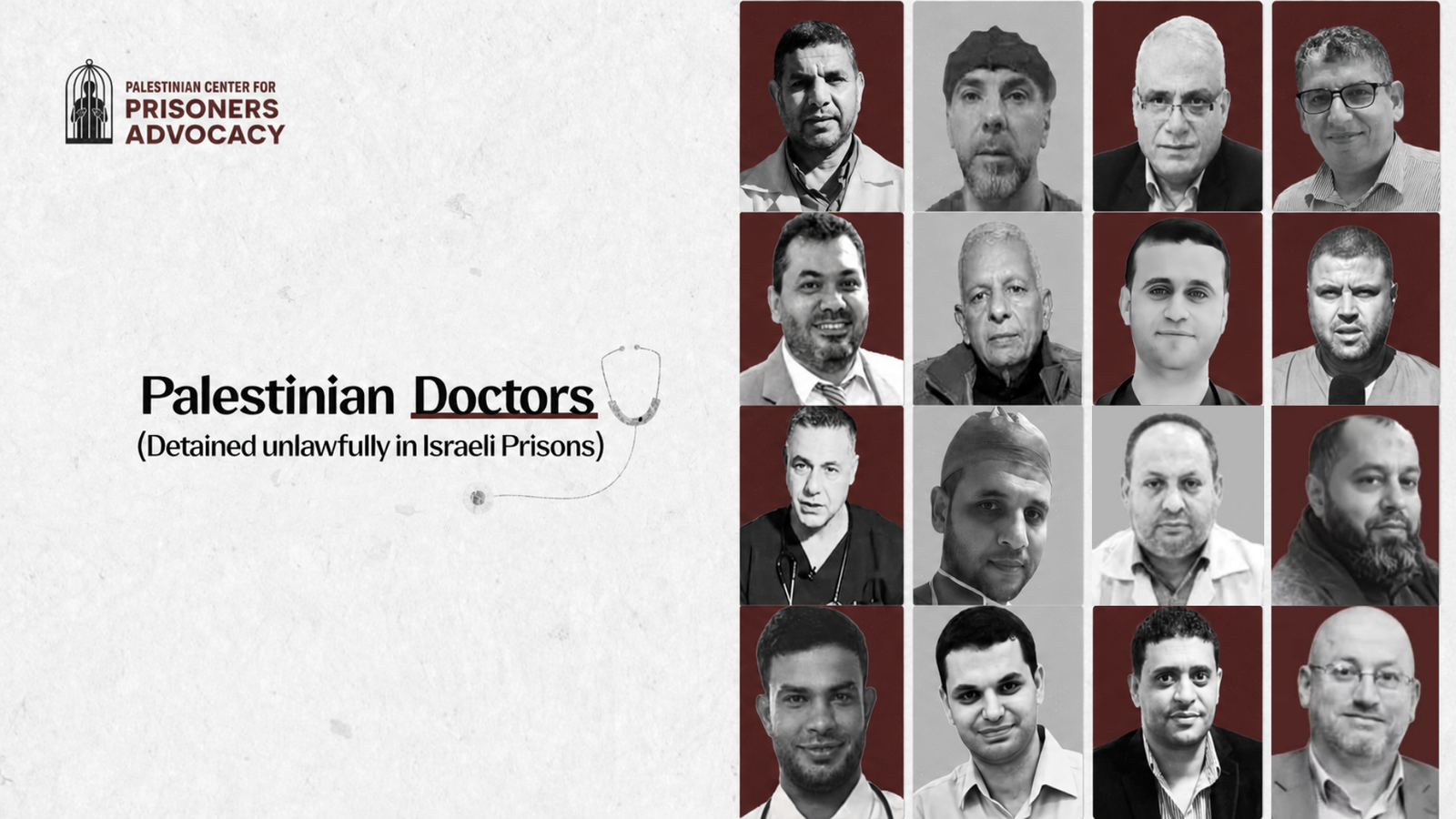
The Palestinian Center for Prisoners Advocacy held a press conference via Zoom on Saturday, highlighting the plight of doctors and healthcare workers detained in Israeli prisons. The conference brought together relatives of detained doctors, journalists, and media representatives as part of ongoing efforts to keep this issue on the agenda of human rights, humanitarian, and media institutions.
The conference was opened by Lina Al-Tawil, Director of the Palestinian Center for Prisoners Advocacy, who stressed that targeting and detaining doctors and medical personnel constitutes a direct attack on the right to healthcare and life. She said it forms part of a systematic policy targeting the Palestinian health sector and its professionals.
Al-Tawil also reviewed the conditions faced by Palestinian prisoners, particularly detained doctors, including torture, starvation, medical neglect, isolation, and denial of family visits. She called on the international community to fulfil its legal and humanitarian responsibilities toward them.
The conference featured moving testimonies from the relatives of several detained doctors, who spoke about their humanitarian suffering and expressed deep concern over their relatives’ health amid the continued lack of information and the denial of visits.
Elyas, the son of Dr Hussam Abu Safiya, presented the latest available information concerning his father. He warned of the seriousness of his health condition in light of recent reports issued by human rights organisations and called for urgent international intervention to save his life.
Aya, the daughter of Dr Marwan Al-Hams, also shared the latest developments regarding her father, stressing that the family continues to suffer in the absence of any reassuring information about his condition in prison.
In an emotional statement, the wife of Dr. Akram Abu Ouda, whom she described as a doctor who had devoted his life to treating patients, spoke about the heavy price the family has paid since his detention. She noted that the family had lost one of their sons without his father being able to say goodbye. After years of loss and deprivation, the family is still waiting for his return, while his children continue to live in the hope of embracing him once again.
Ruba, the daughter of Dr Ghassan Abu Zahri, described the circumstances of her father’s detention from inside Nasser Medical Complex while he was carrying out his professional duties on 16 February 2024. She stated that he had been denied a lawyer’s visit for a year and a half.
The family had also received information indicating that he had lost approximately 45 kilograms of weight and had been injured by a rubber bullet. She added that he had repeatedly appealed through other prisoners to be allowed to meet with his lawyer, raising serious concerns about his life and health.
The wife of Dr Nahed Abu Tuaima also described the family’s suffering since his detention. She stressed that his rightful place is beside his patients in the operating theatre and said that, even in prison, he continues to fulfil his humanitarian mission by treating fellow prisoners and saving them from the consequences of medical neglect. She expressed hope for his return so that the family could be reunited after many long months of separation.
Participants stressed that the continued detention of doctors and healthcare workers, and the violations committed against them, constitute a double crime targeting both Palestinian individuals and the Palestinian healthcare system.
They called on the United Nations, the International Committee of the Red Cross, the World Health Organization, and all human rights institutions to take urgent action to secure their release, guarantee their protection, enable them to communicate with their families and lawyers, and bring an end to the ongoing violations against them inside Israeli prisons.
It is worth noting that 16 doctors, in addition to dozens of healthcare workers, remain detained in Israeli prisons. They face harsh conditions and are denied medical care, visits, and communication with their families.
There are among approximately 9,400 Palestinian prisoners, including patients, children, administrative detainees, and women prisoners, amid escalating violations and policies of torture, starvation, and medical neglect inside prisons.