The Palestinian Center for Prisoners’ Advocacy has documented a harrowing testimony from a former detainee from the Gaza Strip, detailing alleged abuse during his arrest and detention by Israeli forces.
Ahmad Hamdan Abu Ras said he was detained on Thursday, Nov. 16, 2023, while trying to flee south with his wife and their infant son, who was just over one year old. The family was traveling along Salah al-Din Street, near the Netzarim corridor, as they sought to escape heavy bombardment.
In his testimony to the Center, Abu Ras said Israeli soldiers called him by name and ordered his wife to take the child from his arms. “Take the child from his father and do not look back,” he recalled them saying. As his wife and child cried, soldiers fired shots to force him to raise his hands, then ordered his family to continue south without him. He said he has not known what happened to them in that moment.
Abu Ras said his suffering began immediately after his arrest. He was forced to strip down to his underwear, had his hands bound behind his back, and was blindfolded. He said an officer who spoke Arabic took his identification number, scanned his eyes, marked an “X” on his back, and repeatedly used the phrase “execution of the elite.”
He said soldiers from Israel’s Golani Brigade then beat him severely until another officer intervened. By that point, Abu Ras said, blood was flowing from his nose and mouth.
According to his account, he and six other detainees were taken to the Be’eri military site, where they were held for 28 hours in an area under continuous mortar fire and allegedly used as human shields. During that time, he said, they were denied food, water, access to toilets, and the ability to pray, and were forced to urinate on themselves.
The group was later transferred to the Fajja military site. Abu Ras said they were beaten and verbally abused by settlers along the way. The following day, he was moved to Sde Teiman detention camp. There, he said, a soldier inserted a metal rod into his left ear, causing heavy bleeding and permanent hearing loss.
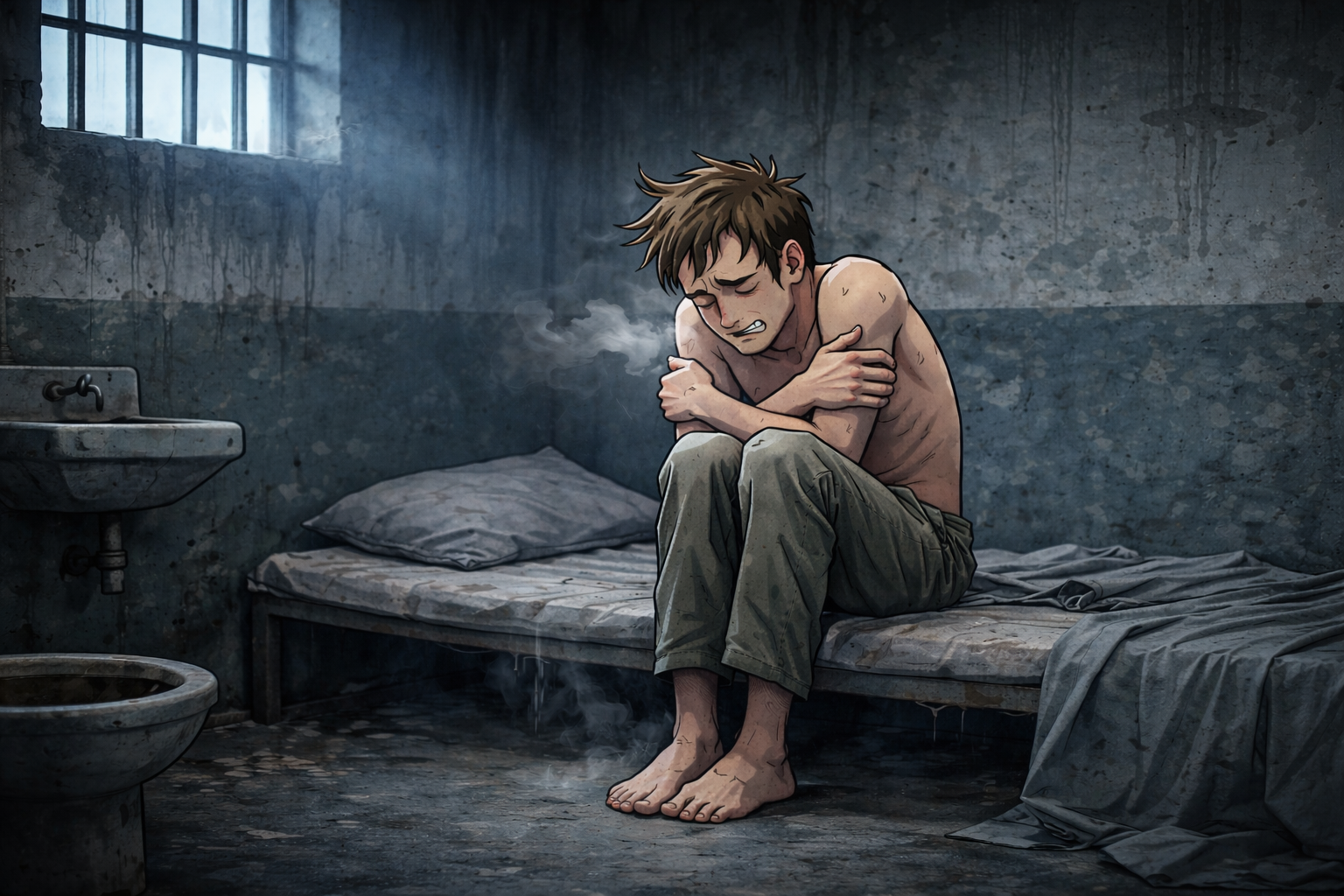
After his personal details were recorded, Abu Ras said he was given gray prison clothes, shackled with iron restraints, and placed in Section Five, Barracks “Aleph,” before being taken for interrogation. During transfers, he said, he was beaten and dragged. Upon arrival, he was stripped naked, dressed in a surgical gown, and thrown into a tent with a stone floor, a thin mattress, and a wet blanket. Loud fans and speakers were used continuously, he said, to prevent him from sleeping.
Abu Ras said the torture he endured during interrogation included the removal of all 20 fingernails, burns inflicted with hot water and heated metal instruments, and repeated beatings. After three days, he was returned to the barracks, where detainees were forced to kneel for up to 16 hours a day. Blankets were confiscated during daylight hours, and detainees were left exposed to extreme cold amid bird droppings.
He recalled that one night, during severe cold, an elderly detainee known as Abu Kaid died beside him. When detainees shouted “God is great,” Abu Ras said guards launched a violent assault, using batons, police dogs, stun grenades, smoke grenades, and rubber bullets.
After 18 days at Sde Teiman, Abu Ras was transferred to Naqab Prison. He said he was beaten during transport in an area known as “the clamp,” suffering two broken ribs. He later underwent a prolonged interrogation at a facility detainees referred to as “the slaughterhouse,” lasting 40 days, more than half of which he said he spent suspended upside down.
In the final part of his testimony to the Palestinian Center for Prisoners’ Advocacy, Abu Ras described harsh detention conditions in Naqab Prison, including isolation, repression, and severe shortages of food and water. He said detainees were forced to wear summer clothing during winter, leading to illness, significant weight loss, and anemia. He said he contracted scabies during his detention.
He said the most painful experiences were witnessing the death of detainee Sayel Abu Nasr, whom he said died from torture and cold, and another detainee who lost his mental stability after prolonged torture and forced medical treatment.
The Center said that as of December, the number of Palestinian prisoners and detainees stood at approximately 9,300. That total includes 1,300 convicted prisoners, 51 women, 350 children, 3,200 administrative detainees, and 1,250 people held under Israel’s Unlawful Combatant Law. All were detained from the Gaza Strip after Oct. 7, 2023.