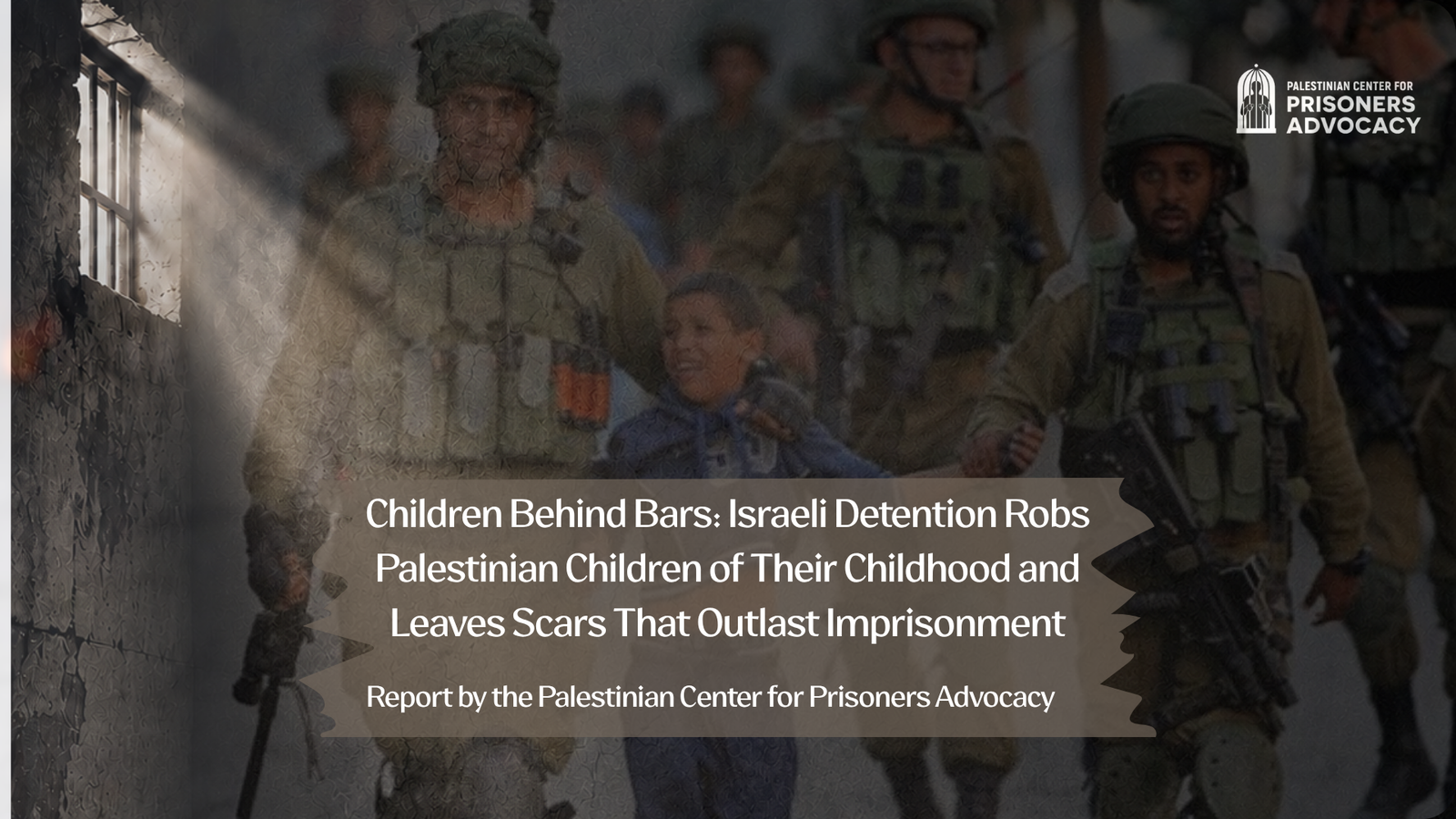
A special report by the Palestinian Center for Prisoners Advocacy on the situation of Palestinian children in Israeli prisons
The detention of Palestinian children in Israeli prisons is no longer an exceptional occurrence or one confined to isolated cases. It has become a recurring feature of Israeli arrest campaigns across the occupied West Bank and Jerusalem. At the same time, the situation of children detained from the Gaza Strip remains far more opaque due to enforced disappearance and the difficulty of obtaining comprehensive information about their numbers and places of detention.
As of early August 2026, approximately 370 Palestinian children were being held in Israeli prisons, most of them in Megiddo and Ofer prisons, among more than 9,400 Palestinian prisoners and detainees, according to data compiled by the Palestinian Center for Prisoners Advocacy.
During the first half of 2026 alone, Palestinian prisoners’ organizations documented 276 cases involving the detention of children in the West Bank and Jerusalem. Since the beginning of the war of genocide, the total number of arrests in the West Bank and Jerusalem has exceeded 25,000, including children, women, and people from different segments of Palestinian society.
The figures also demonstrate Israel’s continued use of administrative detention without charge or trial. Data from Palestinian prisoners’ organizations indicated that the number of children who had been subjected to administrative detention reached 180 by the end of 2025—an unprecedented figure compared with previous periods.
From a Home Raid to Life in Prison
For many Palestinian children, detention begins in the middle of the night or at dawn. Israeli forces raid the family home, often in front of parents and siblings, before taking the child away handcuffed and blindfolded to military vehicles or interrogation centers.
Testimonies from children who have experienced detention repeatedly describe beatings during arrest and transfer, insults and threats, being kept restrained for hours, and being denied food, water, or access to a bathroom before interrogation even begins.
For a 13-, 14-, or 15-year-old child, being taken within minutes from their bed and parents into a military vehicle and transported to an unknown location is itself deeply traumatic—even before considering what they may subsequently face during interrogation or imprisonment.
Previous testimonies concerning interrogation centers describe prolonged questioning, psychological pressure, threats, isolation, and sleep deprivation. Children have also reported that interrogators exploit their fears for their families as a means of pressure and attempt to take advantage of their young age to obtain information or confessions.
Released children have also described being interrogated in circumstances where they felt they had no meaningful protection, while living with the constant fear of not knowing what would happen to them or when they would be allowed to return to their families.
Once transferred to prison, children are not necessarily provided with conditions that take their age and specific needs into account. Instead, they are exposed to many of the same conditions prevailing throughout Israeli prisons, including overcrowding, insufficient food, shortages of clothing and hygiene supplies, and restrictions on movement and family visits.
The risks are even greater for children who are ill or injured. Delayed medical treatment, denial of medication, or malnutrition can quickly cause their health to deteriorate. Children are still developing physically and therefore require nutrition and medical care different from those of adults.
Overcrowding, insufficient water, and shortages of hygiene materials also create conditions conducive to the spread of skin diseases and infectious illnesses—a recurring issue in testimonies from Palestinian prisoners and detainees in recent months.
Children from the Gaza Strip remain among the least documented cases. To date, there are no complete and independently documented lists identifying all children detained from Gaza during the war, particularly those held in Israeli military camps. This makes it extremely difficult to establish their actual number or determine the fate and whereabouts of every detained child.
When a Child Is Released but the Prison Remains With Them
A child’s release does not mean that the experience of detention has ended.
Follow-up documentation and previous testimonies show that some children return home suffering from persistent fear, sleep disorders and nightmares, heightened anxiety, social withdrawal, and a loss of their sense of safety.
Some find it difficult to speak about what they experienced. Their relationships with their families, friends, and schools may change, and it can take a considerable amount of time before they are able to return to their previous routines.
Children also pay a direct price in relation to their right to education. A child who misses weeks or months of school may return facing a significant educational gap. At the same time, the psychological effects of detention can make concentration and learning considerably more difficult.
Some children return to find that their classmates and school curricula have advanced while they were imprisoned. They are therefore forced to address academic setbacks while simultaneously attempting to recover psychologically and socially. This can lead to poorer educational performance, a loss of motivation, and, in some cases, dropping out of school altogether.
Specialized psychological, educational, and social rehabilitation programs for released children remain far below the level of actual need, despite the fact that detention during such a formative stage of life can leave consequences that persist for many years.
The suffering is not borne by the child alone. Families also endure an extended experience of fear and uncertainty, beginning with the moment Israeli forces raid the home, followed by efforts to determine where the child is being held, secure legal representation, follow court proceedings and visitation arrangements, and ultimately cope with the psychological and behavioral changes that may emerge after the child’s release.
Protecting Children Must Begin Before Their Release
The Palestinian Center for Prisoners Advocacy maintains that addressing the issue of detained Palestinian children cannot be limited to documenting their numbers or monitoring court hearings. What is required is a comprehensive protection framework that begins at the moment of arrest and continues after release.
The immediate priorities must include ending violence and abuse against children during arrest and interrogation, ending the use of administrative detention against minors, and ensuring that detained children receive effective legal protection, adequate medical care, appropriate nutrition, family visits, and access to education while in detention.
Released children also require meaningful psychological, social, and educational rehabilitation programs that enable them to return to school and resume their lives, rather than leaving children and their families to face the consequences of an experience far beyond what any child should be expected to endure.
The Palestinian Center for Prisoners Advocacy calls on the United Nations, UNICEF, international organizations, and relevant human rights bodies to treat the detention of Palestinian children as an urgent protection issue, exert meaningful pressure to end violations against them, closely monitor the conditions of sick and injured children, secure access to children detained from the Gaza Strip, and establish their fate and whereabouts.
Palestinian Center for Prisoners Advocacy