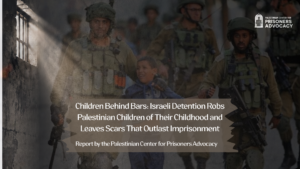
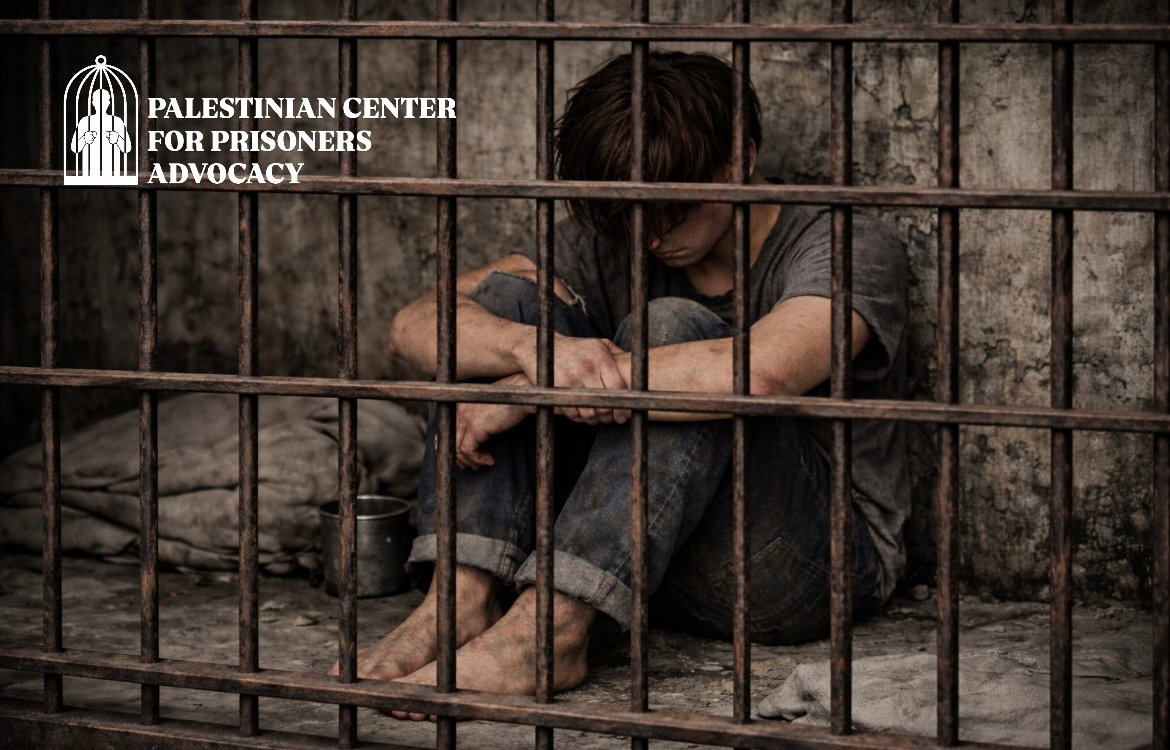
The Palestinian Center for Prisoners Advocacy has documented one of the most severe and harrowing testimonies of a minor detainee whose father was killed, who was subjected to physical and psychological torture, and who witnessed the killing of other detainees beside him.
This testimony is published as part of a series of documentation reports released by the Palestinian Center for Prisoners Advocacy as part of its ongoing efforts to monitor and document grave violations committed against Palestinian prisoners and detainees in Israeli prisons and detention centers, particularly children and minors.
The testimony comes within the broader documentation of crimes committed against detainees from the Gaza Strip during the war. It is based on a direct account given by the released prisoner, identified as “Bashir,” following his release, and is published verbatim to preserve its accuracy and credibility.
Bashir begins his testimony by saying “On the morning of Wednesday, Dec. 27, 2023, I was displaced with my family at Abu Helo West School in the Bureij refugee camp. Suddenly, Israeli forces stormed the school and completely surrounded the area. Everyone — men, women and children — was ordered to go outside after removing their outer clothing and raising their hands. The scene was terrifying. Women were crying and clinging to their husbands and children. My mother was holding my hand, shaking with fear.”
He continues “At that moment, I was not yet 18 years old. I whispered to my mother, ‘Let me go. I’ll see what happens and come back.’ I went out not knowing where I was being taken. Five others and I stood in front of the soldiers. After a humiliating search, I was ordered to step forward. Suddenly, a soldier attacked me and struck my face with his rifle until I lost consciousness. My hands were then bound behind my back, my eyes were blindfolded, and I was thrown into an armored vehicle.”
“A long and brutal journey began to a place I did not know, called ‘Sufa.’ There, the real hell began. I was taken into interrogation, into a room they called ‘the music room.’ The loud music never stopped — it caused severe headaches and shattered the nerves. The cold was extreme. There was no food, no water and no access to a bathroom. Any request, no matter how small, was met with beatings or the release of attack dogs.”
He adds “Once, I asked to use the bathroom. A soldier beat me and released a dog that bit my leg, then poured cold water over my head. I was handcuffed and shackled from behind the entire time. When it was time for interrogation, they dragged me violently across the ground. My bare feet passed over broken glass, tearing my skin and causing heavy bleeding.”
“Inside the interrogation room, they stripped me naked and forced me to wear what they called ‘diapers.’ They attached electric electrodes to my body. They shocked me until I lost consciousness, and when I regained awareness, they shocked me again. After many hours of this torture, I felt that my body no longer belonged to me, as if I had lost all sense of myself.”
Bashir continues “After that, I was transferred to army camps, where I spent 29 days that felt like 29 years. Cold, hunger and daily beatings were constant. They made no distinction between children and adults. I kept shouting, ‘I’m a minor,’ but they responded with insults and more beatings. I suffered from severe dizziness and dehydration. Because I was the youngest, they would summon me and force me to stand handcuffed in front of the fence for hours, just for amusement.”
“On Jan. 24, 2024, I was transferred with others my age to what they called Megiddo Prison for minors. Even the journey was another form of torture. Inside the bus, the curtains were closed, and they beat us and shocked us with electricity. Blood flowed from my nose, and I suffered temporary paralysis. I arrived at the prison barely able to stand.”
“Despite being labeled a ‘prison for minors,’ the reception involved violent beatings they call ‘the welcome.’ We were placed in narrow cages, then five soldiers entered while we were restrained and beat us on our joints and knees for half an hour. They forced us — children — to imitate animal sounds to humiliate us.”
Bashir recounts, “On April 8, 2024, after I officially turned 18, I was transferred alone to Negev Prison, which people call ‘the slaughterhouse of Gazans.’ The reception was another round of beatings. Inside the prison, there was no medical care, no proper clothing and none of the most basic necessities of life. In Section 19A, there was no bathroom. We relieved ourselves in plastic bags and empty hummus containers.”
Describing the most tragic moments, Bashir says “I witnessed the deaths of friends due to illness and deliberate medical neglect. We were denied family visits and endured the bitter winter cold wearing light summer clothes. Three days before my release, on Oct. 9, 2025, prison authorities launched a violent assault on us. They fired tear gas, rubber bullets and stun grenades, released dogs and sprayed us with pepper spray. Many were injured, and our wounds were left untreated.”
“On Oct. 10, I was called to leave as part of the prisoner exchange deal. Until the very last moment, the beatings and insults did not stop. On Oct. 13, 2025, I was released from captivity. The feeling of freedom was immense, but it was mixed with fear for my family.”
“On the way, I met my older brother, Anas. I was overjoyed to see him, but he calmly told me, ‘Father was killed.’ I collapsed and cried. When I arrived home, people welcomed me with great joy, but it was incomplete — my father’s face was absent, and the shadow of loss and war remained present in everything.”
According to the Palestinian Center for Prisoners Advocacy, the number of Palestinian prisoners and detainees had reached approximately 9,300 as of December, including 1,300 sentenced prisoners. The total includes 51 women, 350 children, 3,200 administrative detainees, and 1,250 detainees held under the “unlawful combatant” law — all from the Gaza Strip and detained after Oct. 7.